| SHADOWS ON THE WALL | REVIEWS | NEWS | FESTIVAL | AWARDS | Q&A | ABOUT | TALKBACK | |||||
 Shadows off the beaten path Shadows off the beaten pathIndies, foreign, docs and shorts...
On this page:
ALL THAT'S LEFT OF YOU |
KOKUHO |
SOUND OF FALLING
| |||||
| See also: SHADOWS FILM FESTIVAL | Last update 16.Jan.26 | |||||
|
All That’s Left of You Review by Rich Cline | 
| |||||
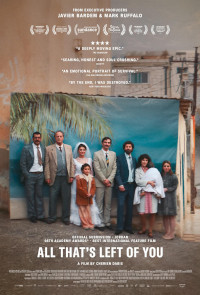 dir-scr Cherien Dabis prd Thanassis Karathanos, Cherien Dabis, Martin Hampel, Karim Amer with Saleh Bakri, Cherien Dabis, Adam Bakri, Maria Zreik, Mohammad Bakri, Salah El Din, Sanad Alkabareti, Muhammad Abed Elrahman, Rida Suleiman, Dominik Maringer, Hayat Abu Samra, Ramzi Maqdisi release US 5.Dec.25, UK 6.Feb.26 25/Palestine 1h25 SUNDANCE FILM FEST Is it streaming? |
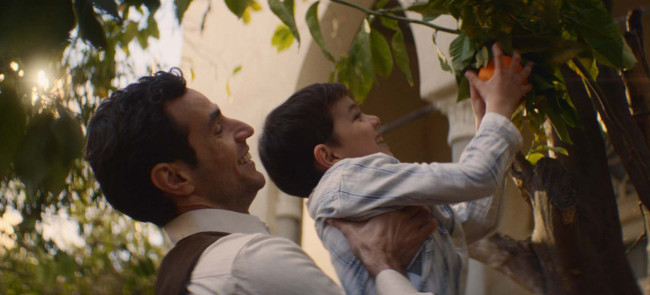 Peppered with vivid moments that carry a strong emotional punch, this melodramatic epic traces Palestine's history over some 65 years through the prism of a family. Using fictional characters to trace real historical events, the story is involving and urgent. Actor-filmmaker Cherien Dabis skilfully creates a range of periods and maintains focus on the people rather than the history, although things get rather soapy along the way. When Zionists take over Palestine in 1948, young Salim (El Din) flees Jaffa with his mother (Zreik) and siblings, while his father Sharif (Adam Bakri) takes a stand in the family home. But he's arrested and sent into hard labour. Three decades later, Salim (now Saleh Bakri) has a wife Hanan (Dabis) and cheeky son Noor (Alkabareti), living with his ageing father (now Mohammad Bakri). Then a cruel Israeli checkpoint leaves him badly shaken. In 1988, teen Noor (now Elrahman) is shot during a protest, and Salim and Hanan must battle bureaucracy to get help. The film actually opens at this point before cycling back to recount the family's history, then progressing to the present day. All of this is seen specifically through Salim's eyes, with Israeli military as astonishingly sadistic villains. As a moral dilemma arrives later on, Salim and Hanan are going to have to get over these feelings, perhaps finding a way to see beyond divisions to a more hopeful future. This idea gives the audience something to think about, even if the circumstances are over-dramatised. Casting the Bakris (father Mohammad and sons Adam and Saleh) adds a powerful connection between the three men in this family. Each of these charismatic actors brings a strong sense of playful energy, intelligence and steeliness. Adam and Saleh also spark nicely opposite the terrific Dabis and Zreik as intelligent women who are willing to fight for their families. And youngsters El Din and Alkabareti add a wonderful blast of curious energy to the film. Events depicted here are properly harrowing, as this family and their entire nation are robbed of their history, homes and possibilities, relegated to second-class citizens who are unable to travel. Indeed, Salim and Hanan can only revisit Jaffa after they acquire foreign nationality, because Palestinians aren't allowed to travel there. Details like this abound throughout the narrative, highlighting truths that are rarely acknowledged, so the film is well worth seeing, even if it over-eggs the important human drama.
| ||||
|
Kokuhō Review by Rich Cline |  MUST
MUST  SEE SEE
| |||||
 dir Lee Sang-il scr Satoko Okudera prd Shinzo Matsuhashi with Ryo Yoshizawa, Ryusei Yokohama, Ken Watanabe, Min Tanaka, Shinobu Terajima, Mitsuki Takahata, Nana Mori, Takahiro Miura, Ai Mikami, Emma Miyazawa, Soya Kurokawa, Keitatsu Koshiyama release Jpn 6.Jun.25, US 20.Feb.26 25/Japan toho 2h54 CANNES FILM FEST TORONTO FILM FEST Now streaming... |
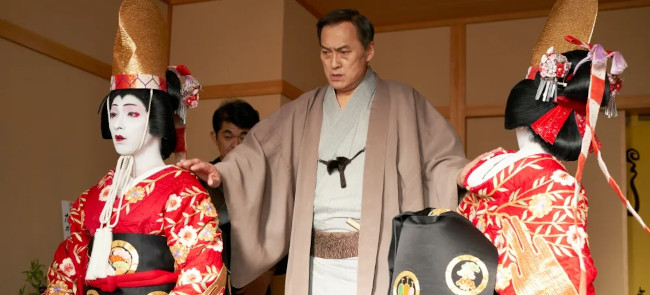 Lavishly produced with glorious costumes and a beautiful attention to period detail, this epic Japanese drama traces the life of a young onnagata, an actor who plays female roles in male-only kabuki theatre. And this one has a mob background. It's a riveting look into the culture of a distinctive art form, with glorious on-stage performances and even more involving back-stage interaction. It's very long, but powerfully well-made. At a performance in 1964 Nagasaki, kabuki master Hanjiro (Watanabe) is impressed by 15-year-old onnagata Kikuo (Kurokawa). But Kikuo's yakuza father is murdered that night. To further his training, Kikuo moves in with Hanjiro, his fellow teacher wife (Terajima) and actor son Shunsuke (Koshiyama), who becomes his best friend. Seven years later, Kikuo (now Yoshizawa) and Shunsuke (Yokohama) get their big break on-stage. Meanwhile, Kikuo's girlfriend Harue (Takahata) won't marry him, while geisha Fujikoma (Mikami) pledges undying love. Over the years, both Kikuo and Shunsuke exerience soaring highs and painful lows in their careers. Spanning five decades, the story reveals Kikuo as an artist willing to do the hard work to be the very best at his craft. Shunsuke calls him "bottomless" when it comes to learning new skills. His talent is even recognised by top onnagata Mangiku (Tanaka), a kokuho or national treasure. By contrast, Shunsuke loves the party lifestyle, relishing his status as the child of a theatre dynasty, even as he recognises his friend's brilliance. All of this feeds into the narrative's ravishing textures. Lead actors Yoshizawa and Yokohama studied kabuki for 18 months to prepare for these roles, which adds superb nuance in their distinct performances. Their vividly shaded relationship is the film's backbone, a brotherly rivalry with fascinating edges, as the apprentice shows more promise than the scion. Their complex bond is tight, as both experience success and failure. Watanabe brings unusual gravitas to his scenes as the harsh teacher who genuinely cares. And Tanaka is luminous as a theatrical legend. Kabuki is heavily stylised and operatic; subtitles reveal plots of plays that unfold with breathtaking costumes and sets. Kikuo's elaborate back tattoo is a constant reminder that he comes from another world. As an outsider, he must use his talent to fight for respect in this closed world. The extended running time allows the filmmakers to properly explore this vibrant culture while creating a beautiful depiction of both brotherhood and the cost of artistic aspiration. It's a wonderful antidote to today's quest for instant fame.
| ||||
|
Sound of Falling In die Sonne Schauen Review by Rich Cline |  MUST SEE
| |||||
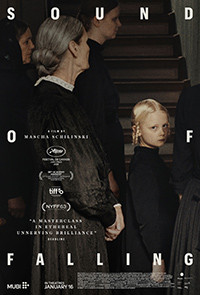 dir Mascha Schilinski scr Louise Peter, Mascha Schilinski prd Lasse Scharpen, Lucas Schmidt, Maren Schmitt with Hanna Heckt, Lena Urzendowsky, Lea Drinda, Laeni Geiseler, Florian Geisselmann, Konstantin Lindhorst, Filip Schnack, Martin Rother, Susanne Wuest, Luise Heyer, Claudia Geisler-Bading, Lucas Prisor release Ger 28.Aug.25, US 16.Jan.26, UK 6.Mar.26 25/Germany 2h35 CANNES FILM FEST TORONTO FILM FEST  Is it streaming? |
 Quietly and at times almost hauntingly observational, this profound German drama explores the inner lives of four generations of mischievous girls living in the same farmhouse. With sparse dialog, director Mascha Schilinski hones in on the characters' innate curiosity. And a subtle whiff of surrealism creates an almost overpoweringly mesmerising vibe. This collage-like film is a skilfully assembled swirl of joy and pain, embracing the mysteries of life. In the 1940s, 9-year-old Alma (Heckt) wonders why everyone can see that mother (Wuest) has a bad stomach, but they all ignore it. A freaky old photograph inspires her sisters to create a ghostly family history. Years later, Erika (Drinda) becomes fascinated with her uncle Fritz (Rother), Alma's older brother who lost a leg as a teen (Schnack). Then in the 1980s, teen Angelika (Urzendowsky) won't acknowledge how her uncle Uwe (Lindhorst) and cousin Rainer (Giesselmann) look at her. In the present day, Lenka (Geiseler) spends holidays in the house, hiding her own dark thoughts. Sliding through nearly a century, the film is beautifully shot and edited to create connections between the past and present, turning this into a haunted house movie that's laced with black humour and inquisitive sexuality. Imagery echoes through the decades, most memorably in scenes set around the eel-filled river that separates East and West Germany. Cinematographer Fabian Gamper uses naturalistic lighting, cleverly stirring in colours as the story moves through time. The sound mix adds an earthy edge with snippets of voiceover and churning rumble. Each member of the large ensemble cast delivers an open-handed, visceral performance, with standout roles for the magnetic young Heckt as the mortality-obsessed Alma and the remarkably engaging Urzendowsky, who expresses Angelika's burgeoning feelings with real power. Her scenes with Geisselmann and Lindhorst bristle with underlying tension. All of the characters feel strikingly rounded, with imaginative ideas and deeper layers that others can never quite see. This creates several indelible moments. The original title translates as Staring at the Sun, and the film boldly explores how one generation feeds into the next in ways that are largely unintended. Because this is a female-eyed view of an abusive patriarchal society, it's laced with provocative details and meanings that unfold in startling directions. This is a stunning depiction of how joy mingles with painful realities that often remain unspoken. As one voiceover ruminates, "It's too bad that you never know when you're at your happiest."
| ||||

See also: SHADOWS FILM FESTIVAL © 2026 by Rich Cline, Shadows
on the Wall
HOME | REVIEWS | NEWS | FESTIVAL | AWARDS
| Q&A | ABOUT | TALKBACK | | ||||


