| SHADOWS ON THE WALL | REVIEWS | NEWS | FESTIVAL | AWARDS | Q&A | ABOUT | TALKBACK | |||||||||||||||||||||||||||||
 Shadows off the beaten path Shadows off the beaten pathIndies, foreign, docs and shorts...
On this page:
COPPER |
PHANTOMS OF JULY |
THE STRANGER
| |||||||||||||||||||||||||||||
| See also: SHADOWS FILM FESTIVAL | Last update 1.Feb.26 | |||||||||||||||||||||||||||||
|
Copper Cobre Review by Rich Cline | 
TORONTO FILM FEST Is it streaming?
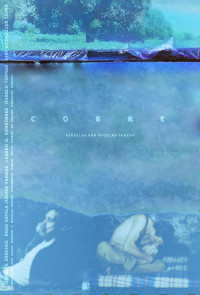
| 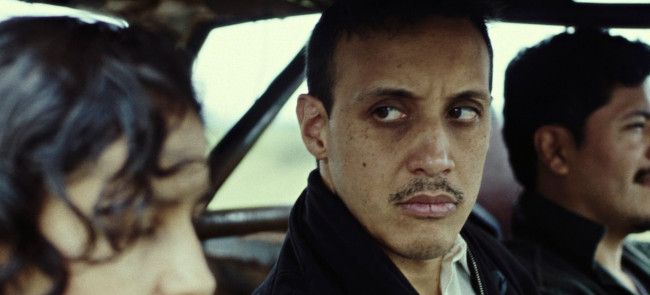 With an edgy, idiosyncratic approach, director Nicolas Pereda uses witty camerawork to add both insight and amusing detail as the protagonist grapples with a moral dilemma. This stylishly offbeat drama's low-key vibe is mesmerising, internalising the story in ways that are intriguing and sometimes unnerving. The quietly meandering narrative might frustrate some viewers, but this is a fascinating little film that finds surprising truths along the way. In rural Mexico, miner Lazaro (Rodriguez) discovers a body along the road while riding his motorbike to work. But he's frightened to report it to police. His mother Teresa (Sanchez) advises him to keep quiet, but this begins to eat away at him. Looking for an excuse to avoid work, Lazaro clashes with both his doctor (Villegas) and his boss (Barreiro) about his breathing difficulties. So he cuts a bizarre deal with another doctor (Lopez) to get the oxygen tank he thinks he needs. Then someone claims to have witnessed him with the body. Scenes continually make knowing observations that resonate much more widely beyond this sleepy corner of the world. Quirky camerawork simply watches random conversations as characters go about their business, leaving lots of key scenes off-screen. It turns out that this is the third body dumped along the road in recent weeks, hinting at the wider social situation. And because there's not much to do around here, Lazaro spends free time hanging out with his young aunt Rosa (Juarez) and her mechanic boyfriend (Torres). Performances are superbly understated, creating a documentary tone due the unconventional way scenes are shot and edited mainly to observe reactions. As Lazaro, Rodriguez is hilariously deadpan about everything, and he knows that most people don't like him. Juarez's sardonic Rosa asks him why he always smiles at her. "I don't," he replies unconvincingly. A scene in which Rodriguez, Juarez and Sanchez roleplay a conversation cleverly reveals underlying feelings. The film looks terrific, beautifully capturing life in this isolated community. And Pereda resists showing many of the key story elements, including the body and the mine, instead playfully digging into deeper ideas. Lazaro's doctor and boss both advise him to stop smoking, but he claims that his health problems relate to spending too much time in the mine. He is clearly deflecting his feelings about the violence and corruption that eerily remain just out of view.
|
| Phantoms of July Sehnsucht in Sangerhausen Review by Rich Cline |
| 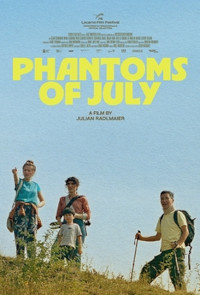 dir-scr Julian Radlmaier prd Kirill Krasovski with Clara Schwinning, Maral Keshavarz, Henriette Confurius, Paula Schindler, Ghazal Shojaei, Kyung-Taek Lie, Buksori Lie, Marlene Hauser, Jeremie Galiana, Jakob Schmidt, Andreas Dohler, Luise von Stein release US Oct.25 afi, Ger 27.Nov.25 25/Germany 1h30 Now streaming...
| 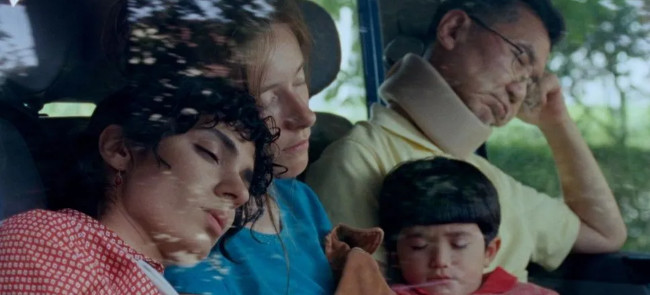 With multiple strands connected by a mysterious blue stone, this German comedy unfolds with deadpan humour about the absurdities of everyday life, whatever the period. Writer-director Julian Radlmaier assembles seemingly random scenes that create a loose narrative sensibility. It all feels rather meandering and silly, but there are several lovely observations along the way. And it also creates a terrific sense of a small-town community and its surroundings. In a grand house, 18th century maid Lotte (Schindler) is sure there's more to life than emptying chamberpots. So she runs away. In the present day, married Ursula (Schwinning) works two jobs. After a shift, she meets violinist Zulima (Confurius), feeling a spark of attraction that encourages her to do something reckless. Meanwhile, aspiring influencer Neda (Keshavarz) is nursing a broken arm while shooting videos in the area. After spotting her friend Marjam (Shojaei) from back home in Iran, she takes a tour with guide Sung-Nam and his young grandson (Kyung-Taek and Buksori Lie). After finding the blue rock, both Lotte and Ursula feel a gentle urge to break out of their routine, and Neda feels similarly trapped (and will encounter the stone later). Quirky touches abound, as a camel-riding operation continually passes by, taking tourists to the local monuments. Two naked ramblers turn up at inopportune moments. And Sung-Nam is hoping that Neda can catch some of the local ghosts on-camera. Maybe she will when she ventures into same cave where Lotte hid some 250 years earlier. Performances are enjoyably low-key, creating understated connections between disparate characters. None of these people know each other, as their lives collide in surprising ways. When they meet, Ursula and Neda are both frustrated because things aren't going their way. Schwinning and Keshavarz play their softening attitudes beautifully. And Lie's Sung-Nam adds intriguing running commentary. Their eclectic group sparks a superb dynamic. One repeated idea is that unspoken longing can creep up on us at the most unexpected moments, and that random events can nudge us in new directions. Ursula's colleagues bemoan the influx of immigrants into Germany, but she likes having them as neighbours. When police turn up, everyone is sure they are going to be arrested for their own reason. And the film's key point is that we are generally rather oblivious about everything.
|
| The Stranger L’Étranger Review by Rich Cline |  MUST
MUST  SEE SEE
VENICE FILM FEST  Is it streaming?
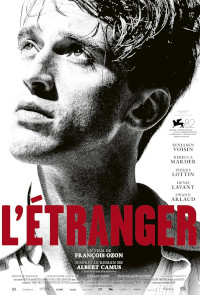
| 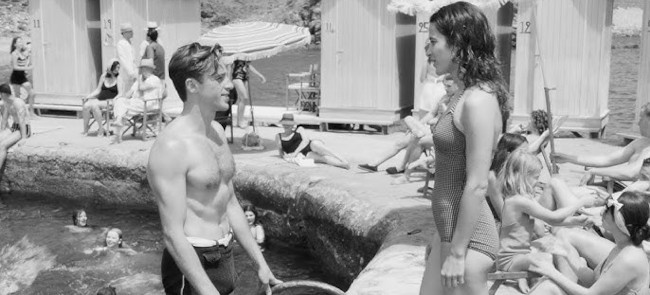 Shot like a period movie in luxuriant black and white, Francois Ozon's adaptation of Albert Camus' classic novel is utterly mesmerising. While the plot and lead character are almost unnervingly matter-of-fact, nuanced ideas ripple provocatively through each scene, pulling us into this off-handed exploration of morality. And even though the story is set in the 1930s, it becomes a frighteningly timely reflection of where the world is right now. In Algiers, the indifferent Mersault (Voisin) struggles to feel sad that his mother (Perrier) has just died. Meanwhile, he rekindles romance with Marie (Marder), but her professions of love and desire for marriage are only mildly interesting to him. Then his neighbour Raymond (Lottin) pulls him into a clash he is having with Moussa (Dehkani), the young Arab brother of his mistress Djemila (Bouzaouit). And when Mersault and Marie travel to the seaside with Raymond, Moussa confronts them with a knife. Where this goes puts Mersault on trial for a murder he refuses to explain. Camus' absurdist storytelling often feels random and even callous in its details. But Ozon's superbly deadpan approach mixes dark humour with emotional resonance, adding a jolt to Mersault's eerily dispassionate demeanour. Cinematographer Manu Dacosse's imagery has a vintage cinematic grain that shimmers with light and texture. All of this augments the central exploration of social expectations and constraints, as Mersault chooses casual honesty, refusing to play by the usual rules. Voisin's astonishing performance somehow makes this recalcitrant young man hugely sympathetic. Mersault says he doesn't feel anything, but Voisin hints otherwise, which makes his behaviour both disturbing and oddly understandable. His scenes with the superb Marder's open-handed Marie buzz with their offbeat connection. And the tangled web between them and Lottin's wonderfully oily Raymond stretches out to the always excellent Lavant's panicky neighbour Salamano and Bouzaoult's soft-spoken Djemila, who gives the film a soulfulness that brings the story's colonial themes into focus. Indeed, one of the central topics here is how French concepts of religion and justice are irrelevant in Algerian culture, reflected in the colonisers' endemic racism. This also echoes in Mersault's emotional detachment, his belief that everything is ultimately meaningless. That he dares to speak this aloud is his real crime, and this is distilled in his chilling encounter with a perplexed prison chaplain (Arlaud) in the final act, highlighting how ineffectual simplistic Western Christianity can be in the face of earthy, everyday truth.
| 
See also: SHADOWS FILM FESTIVAL © 2026 by Rich Cline, Shadows
on the Wall
HOME | REVIEWS | NEWS | FESTIVAL | AWARDS
| Q&A | ABOUT | TALKBACK | | |||||||||||||||||||