| SHADOWS ON THE WALL | REVIEWS | NEWS | FESTIVAL | AWARDS | Q&A | ABOUT | TALKBACK | |||||||||||||
 Shadows off the beaten path Shadows off the beaten pathIndies, foreign, docs and shorts...
On this page:
LITTLE AMELIE |
SCARLET |
SIRAT
| |||||||||||||
| See also: SHADOWS FILM FESTIVAL | Last update 4.Dec.25 | |||||||||||||
|
Little Amélie or the Character of Rain Amélie et la Métaphysique des Tubes Review by Rich Cline | 
| |||||||||||||
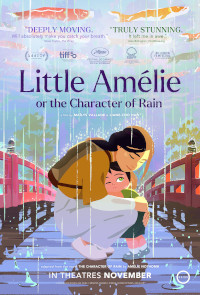 dir Mailys Vallade, Liane-Cho Han scr Liane-Cho Han, Aude Py, Mailys Vallade, Eddine Noel prd Claire La Combe, Edwina Liard, Henri Magalon, Nidia Santiago voices Loise Charpentier, Victoria Grosbois, Marc Arnaud, Laetitia Coryn, Haylee Issembourg, Isaac Schoumsky, Yumi Fujimori, Cathy Cerda, Francois Raison, Emmylou Homs release Fr 25.Jun.25, US 31.Oct.25, UK 13.Feb.26 25/France 1h17 CANNES FILM FEST TORONTO FILM FEST  Is it streaming? |
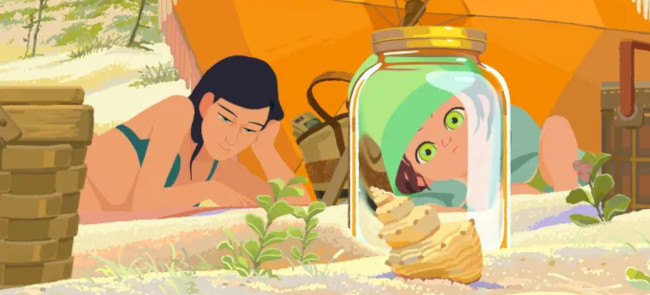 With an eye-catching design that looks like a colourful children's storybook come to life, and a cheeky attitude that adds spark to the characters, this animated French-Belgian-Japanese odyssey sees the world through the eyes of a tiny girl who thinks she's the centre of the universe. So even if the narrative sometimes feels a little too pointed, this movie is utterly gorgeous to look at, and warmly moving too. In 1969, Belgian diplomat Patrick (Arnaud) lives in Japan with his pianist wife Daniele (Coryn) and three rambunctious kids: bright daughter Juliette (Issembourg), bratty son Andre (Schoumsky) and tearaway toddler Amelie (Charpentier). Thankfully, Granny Claude (Cerda) and nanny Nishio (Grosbois) arrive to help with the little one. As Amelie explores the gardens around the house, she also crosses paths with the stern landlady Kashima (Fujimori), who's furious that Nishio spends so much time with loathed Europeans. And while Amelie's siblings struggle to understand her fiercely individualistic personality, she makes discoveries they can't begin to imagine. Amelie's running internal monolog often overstates her attempts to make sense of new discoveries and get reactions from her family. Granny introduces her to the joys of white chocolate from Belgium, while Nishio thrills her with Japanese mythology. This reflects the push and pull of Amelie's identity. Indeed, Amelie's connection with Nishio emerges at the centre of the story, linking her to the land of her birth. Meanwhile, Nishio must balance Kashima's disapproval with her growing love for Amelie and her family. There is a range of experience here, from goofy comedy to some intensely scary moments. When Amelie asks Nishio about death, she describes losing her family during the war in an inventively animated sequence that's darkly emotional. And a series of events on Amelie's third birthday remind her that Japan isn't actually her home. One day she will have to move to Belgium, a place that's completely foreign to her. The animators skilfully capture the changing seasons while finding bursts of energy in each of the characters. The colours and brushstrokes are simply beautiful. Amelie learns that her name means rain in Japanese, appropriately because it's so precarious, dangerous and tempestuous (the original French title refers to God-like tubes). This is a film packed with lessons, as Amelie begins to understand the nature of sadness and longing, as well as the power of memory. It's a reminder to see life every day with eyes wide open.
| ||||||||||||
|
Scarlet Review by Rich Cline |
| |||||||||||||
 dir-scr Mamoru Hosoda prd Yuichiro Saito, Nozomu Takahashi, Toshimi Tanio voices Mana Ashida, Masaki Okada, Koji Yakusho, Masachika Ichimura, Yuki Saito, Yutaka Matsushige, Kotaro Yoshida, Kazuhiro Yamaji, Tokio Emoto, Munetaka Aoki, Shota Sometani, Kayoko Shiraishi release Jpn 21.Nov.25, UK 12.Dec.25, US 6.Feb.26 25/Japan Columbia 1h51 VENICE FILM FEST TORONTO FILM FEST Is it streaming? |
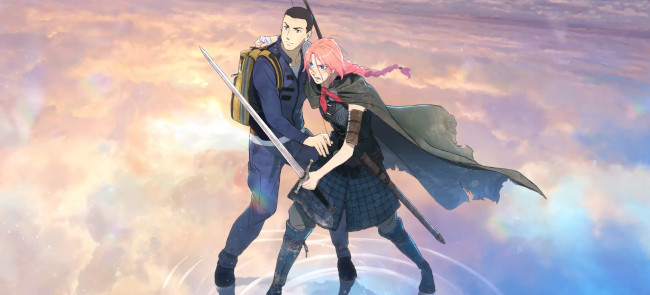 Inventively blending anime-style visuals with epic-scale digital animation, Japanese filmmaker Mamoru Hosoda invokes classic Shakespearean elements throughout this epic quest for vengeance. The imagery is often spectacular, rendered with a cinematic sensibility that continually takes us aback with unusual details. And while the plot sometimes feels like a fantasy variation on Hamlet, it also tells a new story in a fresh way that's involving and ultimately moving. In 16th century Denmark, young Scarlet (Ashida) is horrified when her father King Amleth (Ichimura) is falsely accused and executed by his power-hungry brother Claudius (Yakusho), in cahoots with her cruel stepmother Gertrude (Saito). So Scarlet trains to be a fierce warrior and take Claudius down. But he poisons her, and she awakens in the underworld. And she won't let this stop her. Then she meets modern-day paramedic Hijiri (Okada), who doesn't believe that he's dead. He joins with Scarlet as she faces various challenges while seeking the elusive path back to the living world. It's amusing to see Hijiri reject Scarlet's everyday swords-and-knives violence, instead brokering peace among warring tribes in this foreboding landscape. And Scarlet dismisses his do-gooder ways. On the other hand, she sees his ability to cure members of a camel caravan they join with his medicine, making friends with people she's afraid to trust. Both of them learn to see the world through new eyes, and it's fascinating to watch them begin to react differently to the challenges they face. Hosoda spent more than four years refining the look of this film, determined to create something distinct from both 2D Japanese anime and Hollywood's 3D digital approach. The imagery here includes vast set-pieces with enormous battles, expansive landscapes, crowds of thousands and even a dazzling volcanic eruption. But the focus remains tightly on Scarlet and her connection with this strange young man. Both of them are stubborn and likeable as this situation changes them profoundly. Scarlet begins to realise that if she had been born in a different time, perhaps she could have avoided all this violence and torment. But she also can't bear the thought that her father wanted her to forgive the person she hates the most. And the film's strongest moments involve the way she grapples with the difficulty of letting go of her anger and living in a way that makes the world a better place. A series of climactic scenes are both jaw-dropping and simply beautiful.
| ||||||||||||
|
Sirāt Review by Rich Cline |  MUST
MUST  SEE SEE
CANNES FILM FEST TORONTO FILM FEST LONDON FILM FEST
Is it streaming?
| 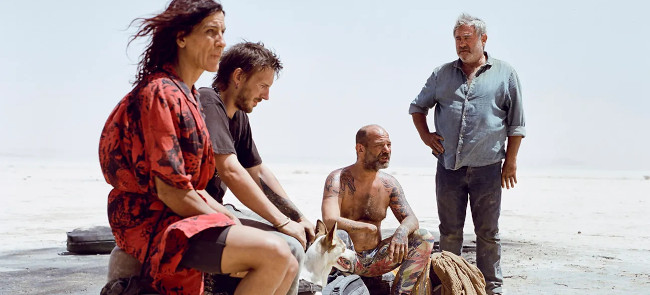 Named after the bridge that crosses hell to reach heaven, this North African film is instantly mesmerising as it pulses to insistent electronic music while shifting into an intensely involving odyssey. Creating a loose but vividly driving narrative, director Oliver Laxe fills the screen with stunningly tactile details that continually take us aback with unusual beauty and deeper meaning. Where the story goes is both harrowing and moving. Arriving at an epic rave in the desert, Luis (Lopez) is with his preteen son Esteban (Nunez Arjona) and their adorable dog Pipa, searching for his missing daughter. But she's probably at another party further across this war-torn country, so they join a ragtag caravan travelling through the parched landscape. The perilous terrain is a challenge for their minivan, but five ravers (Bellamy, Gadda, Herderson, Janvier and Oukid) offer them assistance. Along the way, they share various adventures, becoming a family. But there are also severe dangers in this wilderness, both natural and hellishly man-made. Crowds of gyrating, blissed-out clubbers accompanied by trance music and a spectacular laser show give the setting an otherworldly ambience that's disrupted by heavily armed soldiers ordering them to evacuate. What follows is a cross-country journey with an epic Mad Max feel to it. And little Pipa even takes an accidental acid trip. Later along the road, heart-stopping events leave us absolutely floored. And the journey becomes increasingly wrenching from there. Lopez gives Luis a lovely tenacity, a man who hasn't heard from his daughter for six months and isn't willing to stop searching for her. His reactions to the things that happen are often overwhelmingly honest. The young Nunez Arjona matches his quiet determination and has a more generous nature. He also finds it easier to slot in with these five quirk-filled travelling companions, who are played by non-actors with remarkable full-bodied authenticity. Few films dare to tell this kind of story with such unflinching emotional intensity, creating a true-to-life mix of joy and pain with the power to send us reeling. The tension grows so terrifying that the film shifts into surreal, sunshiny horror. This makes several sequences feel seriously wrenching. But the way these messy people come together to hold each other is simply gorgeous. So this story becomes both a celebration of how scars make us beautiful and a lament for the violent world we have created.
| 
See also: SHADOWS FILM FESTIVAL © 2025 by Rich Cline, Shadows
on the Wall
HOME | REVIEWS | NEWS | FESTIVAL | AWARDS
| Q&A | ABOUT | TALKBACK | | ||||||||||