| SHADOWS ON THE WALL | REVIEWS | NEWS | FESTIVAL | AWARDS | Q&A | ABOUT | TALKBACK | |||||||||||||||||||||||||||||
 Shadows off the beaten path Shadows off the beaten pathIndies, foreign, docs and shorts...
On this page:
LEFT-HANDED GIRL |
SISU: ROAD TO REVENGE |
300 LETTERS
| |||||||||||||||||||||||||||||
| See also: SHADOWS FILM FESTIVAL | Last update 15.Nov.25 | |||||||||||||||||||||||||||||
|
Left-Handed Girl Review by Rich Cline | 
CANNES FILM FEST TORONTO FILM FEST  Is it streaming?
| 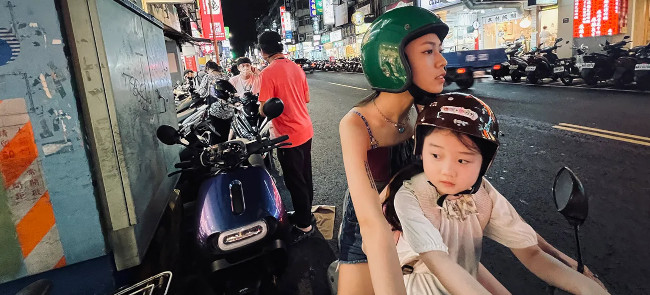 Skilfully shot on an iPhone with bracingly naturalistic performances, this film has the feel of a fly-on-the-wall documentary. Director Shih-Ching Tsou, who wrote the script with Sean Baker, captures everyday life for a very modern multi-generational family. Each of the lively characters is a bundle of attitudes and behaviours, which makes them almost eerily easy to identify with. It's a funny, surprising and thoroughly entertaining film. Cheeky young I-Jing (Ye) is moving to Taipei with her mum Shu-Fen (Tsai) and angry teen sister I-Ann (Ma) to be closer to their grandparents. Although Grandma (Chao) is annoyed by I-Ann's slutty dress sense, and Grandpa (Chen) is horrified that I-Jing is left-handed, insisting that she stop using her "devil hand". I-Jing thinks Grandpa smells like stinky tofu. Meanwhile, Shu-Fen opens a noodle stall, and I-Ann defiantly does her own thing. Soon, each of them finds herself in trouble, and they might need to put their heads together to get out of this. Interaction is fairly full-on, especially as various issues escalate. Everyone tells I-Jing to listen and not speak around adults, but her curiosity has no boundaries. Witnessing everyone blurring moral lines, it's unsurprising that she begins stealing things, blaming it on her devil hand. I-Ann is having her own crisis, mainly due to a fling with her boss (Hsia). And Shu-Fen is trying to hold everything together, but nothing is going her way. Each character takes an internalised journey, largely oblivious to those around them. Ye's I-Jing is busy and determined, struggling to make sense of what grown-ups do and say. Ma's tearaway I-Ann becomes the most provocative figure, discovering the impact of her fragmented life and rebellious nature. Tsai finds underlying emotion in Shu-Fen's struggle both with her business and home life, rejecting help from a nice guy (Huang) who truly likes her. And Chao's Grandma gets in trouble for running her own scam. All of this plays out as a slice of life with bright colours, sparky people and engagingly messy situations. Because of old-world traditions like right-handedness and male-only inheritance, these women must think outside the box. And they need to learn how to be more sensitive to the needs of their friends and family. When repercussions of various actions become apparent, the people who rise to responsibility are unexpected. So where the story goes is painful, forcing people to accept awkward truths. But this is a remarkable celebration of the deeper connections that make life meaningful.
|
| Sisu: Road to Revenge Sisu 2 Review by Rich Cline | 
|  dir-scr Jalmari Helander prd Petri Jokiranta, Mike Goodridge with Jorma Tommila, Stephen Lang, Richard Brake, Ergo Kuppas, Anton Klink, Einar Haraldsson, Sandy E Scott, Jaakko Hutchings, Tommi Korpela release Fin 22.Oct.25, US/UK 21.Nov.25 25/Finland Stage 6 1h28 See also: 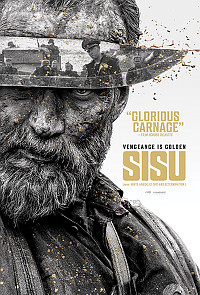 Now streaming...
| 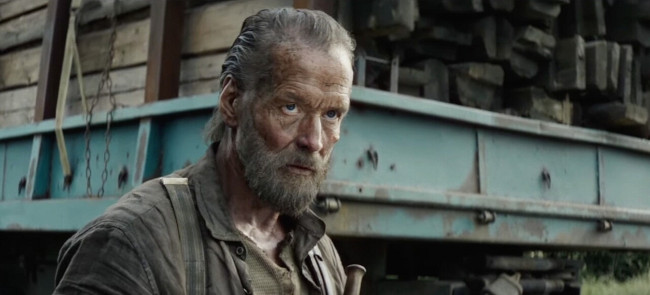 Following on from 2022's violently entertaining action romp, which took on Nazis at the end of World War II, this sequel carries on delivering even more brutal tongue-in-cheek nastiness, this time against the Soviets. Jorma Tommila's hero once again says nothing as he defends himself and evens the score, demonstrating sisu, the Finnish word for last-gasp heroic resilience. Remarkably simple and outrageous, this is another entertaining guilty pleasure. After the war ends in 1946, Aatami (Tommila) travels home to Karelia in what is now the Soviet Union, mourning his murdered family before dismantling his log cabin to take it back to Finland. But a KGB boss (Brake) hears that he has crossed the border, then releases vicious commander Igor (Lang) from his Siberian prison to stop Aatami for good. Much easier said than done, especially because Aatami now sees a chance to avenge his family. Fiercely determined, he must first get through an army of Igor's goons before taking on the man himself. There isn't much to these characters beyond their tenacity, as both Aatami and Igor square off in a variety of scenarios that involve both massive firepower and sharp blades. Everyone else on-screen is disposable, and indeed they are swiftly dispatched in wildly brutal ways, with their fatal injuries rendered mainly through practical effects rather than digital trickery. The makeup work is especially impressive on Aatami's astonishingly scarred body. As before, Aatami never says a word, communicating to his faithful dog with nods. His determined face and earthy grunts express everything we need to know as he squares off for each new onslaught. Tommila vividly plays him as a man who has been through a lot and is unwilling to stop now, pushing through extreme pain to do what he has to. Lang's Igor is more of a sneering villain, arrogant and dangerously overconfident, but also just as unwilling to give up the fight. Brisk and brief, the film keeps us thoroughly engaged through each set-piece, including whizzy aerial attacks and a skilfully choreographed sequence on a train that involves carriages of sleeping soldiers as well as an armed missile. Everything that happens is wildly over the top, while the underlying story is remarkably simple, following a man who needs to start his life over again. This adds some pathos to the rampaging carnage, while the underlying irony finds some nervy present-day parallels. But it's the gleeful grisliness that most viewers will remember.
|
| 300 Letters #300Cartas Review by Rich Cline |
|  dir Lucas Santa Ana scr Gustavo Cabana, Lucas Santa Ana prd Murray Dibbs, Lucas Santa Ana with Cristian Mariani, Gaston Frias, Bruno Giganti, Jorge Thefs, Franco Mosqueiras, Jordan Romero, Francisco Cottet, Esmeralda Segui, Tomas Litte, Lucas Santa Ana, Lucero Cordoba, Lucas Provenzano release US 14.Nov.25 25/Argentina 1h30 Is it streaming?
| 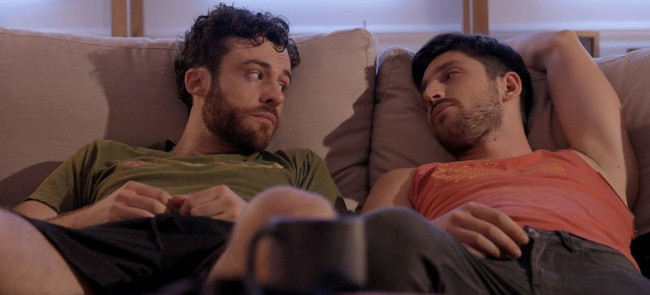 There's a cheeky vibe to this comedy from Argentina, which inventively traces the arc of a relationship both in the present and in retrospect. Its central point is that even people who aren't looking for something serious want a deeper connection. This couple's relational highs and lows are beautifully directed by Lucas Santa Ana, and scenes are played with insight by actors who are relaxed, authentic and sexy. On the first anniversary of his relationship, Jero (Mariani) is blindsided when his boyfriend Tom (Frias) simply walks away, leaving a box of 300 numbered letters written throughout their time together. His friend Esteban (Giganti) comes around to help make some sense of this. Even though he urges Jero to move on, he starts reading the letters, reliving his time with Tom. Their relationship started out free and easy, then grew more awkward as things began getting serious. Jero can't believe he missed the signs, knowing that they were in love, weaving their lives together. As he reads the letters, Jero discovers that Tom was drawn in by the sex and then surprised by the deeper connection that quickly grew between them. There's an intriguing contrast between their jobs, Jero in crypto and Tom as a poet and teacher. Both of them are happy to remain casual, but the issue of a stronger bond repeatedly comes up. Meanwhile, there's the younger guy (Mosqueiras) crushing on Tom, and then later as he reads the letters, Jero hooks up with Esteban's hot friend (Romero). Mariani and Frias are superbly natural as two young guys who are trying to avoid romance, even as they begin to realise that they're already too far gone. The actors have a loose physicality, often shirtless in the warm weather, always up for playful sex. They nicely underplay the bigger emotions that emerge along the way, which makes them easy to identify with. Giganti adds some nice textures of his own as Jero's straight-talking friend. He genuinely cares. Jero can't understand how he fell in love with someone who could do something this cruel to him. And he becomes increasingly obsessive about finding the answer. Revelations and observations in these letters frequently remind Jero that not everything about love is laughter and happiness. They also help him see their time together through another perspective. And along the way, this enjoyable and moving film has insightful things to say about why relationships so often fail.
| 
See also: SHADOWS FILM FESTIVAL © 2025 by Rich Cline, Shadows
on the Wall
HOME | REVIEWS | NEWS | FESTIVAL | AWARDS
| Q&A | ABOUT | TALKBACK | | ||||||||||||||||||