| SHADOWS ON THE WALL | REVIEWS | NEWS | FESTIVAL | AWARDS | Q&A | ABOUT | TALKBACK | |||||
|
Winter of the Crow
Review by Rich Cline |
| |||||
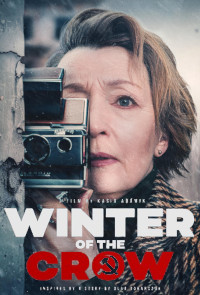 dir Kasia Adamik scr Sandra Buchta, Kasia Adamik, Lucinda Coxon prd Olga Chajdas, Stanislaw Dziedzic, Katarzyna Ozga, Nicolas Steil, Samantha Taylor with Lesley Manville, Zofia Wichlacz, Andrzej Konopka, Tom Burke, Sascha Ley, Miron Jagniewski, Jakub Guszkowski, Melissa Dalton, Magdalena Smalara, Rhianne Barreto, Cezary Studniak, Dariuz Bronowicki release US 9.Oct.26, UK 16.Oct.26 26/Poland 1h52 

Is it streaming? |
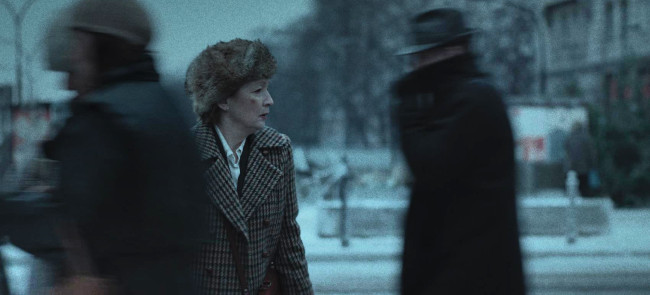 Set in Soviet-era Poland, this thriller has an enjoyably churning, gritty tone, as a middle-aged woman is stranded in a freaky situation that grows increasingly suspenseful. Filmmaker Kasia Adamik skilfully creates a grainy period sensibility that emphasises the snow and shadows, with danger lurking in every corner. The script may rely a bit too heavily on coincidences, but it's involving and strikingly well-made, with superbly edgy action. In wintry 1981 Warsaw, boarders are closed by martial law, stranding visiting British psychiatry professor Joan (Manville) without her passport or luggage. She can't get hold of her contact Alina (Wichlacz) because phone lines are dead, and she's horrified to see tanks in streets and people arrested around her. Then she witnesses the murder of a student, and finds herself being hunted by the Crows, the secret police force. She manages to find Alina's uncle Henryk (Konopka), but he's on the run as well. What she really needs is to get to the British Embassy. During her conference speech, Joan is interrupted by a lively protesting student who have been awakened by recent cultural openness. They know they must speak out while they can. So pictures Joan snaps with her trusty Polaroid begin to take on a pressing urgency. Throughout the film, crows repeatedly appear, haunting Joan by day as well as in her stylised black-and-white dreams. As she gets ever-more deeply involved in Alina's and Henryk's precarious positions, she gains a new perspective on her own life. As usual, Manville brings her natural style to a complex, rather prickly role. Joan is demanding and impatient, patronising about her expertise. But Manville makes it easy to identify with her frustration, especially as it pushes her to fight for her survival, wondering who she can trust. The cast around her are skilfully authentic, creating a vivid sense of the time and place, and also the stakes involved as the system closes in around them. And the excellent Burke brings some offbeat textures as the British ambassador. Challenged by the language barrier, Joan meets locals who are compassionate and helpful. Their openness and passion for life begin to seep into her consciousness as her predicament becomes increasingly perilous. Watching her begin to take a stand for something meaningful, perhaps for the first time in her life, is fascinating, as are the parallels with where the world has found itself nearly half a century later. So while there's a terrific blast of hope in this narrative, it's also a warning.
R E A D E R R E V I E W S  Still waiting for your comments ... don't be shy.
|
||||
© 2026 by Rich Cline, Shadows on the Wall | |||||
| HOME | REVIEWS | NEWS | FESTIVAL | AWARDS | Q&A | ABOUT | TALKBACK | |||||

